
Physical Therapy Guide to Hamstring Injuries
A hamstring injury occurs when one or more of the three hamstring muscles or tendons (at the back of the thigh) are torn or strained. Hamstring strain or tear injuries are common in activities that involve high-speed running, jumping, kicking, and/or explosive lower extremity movements. Sports, such as football, soccer, rugby, and track, have the highest frequency of injuries. After tearing a hamstring muscle, a person is more than three times more likely to suffer a subsequent injury. In most cases, hamstring strain injuries are successfully managed with physical therapy.
Physical therapists are movement experts. They improve quality of life through hands-on care, patient education, and prescribed movement. You can contact a physical therapist directly for an evaluation. To find a physical therapist in your area, visit Find a PT .
What Are Hamstring Injuries?
The hamstring muscle group includes three muscles along the back of the thigh that connect the pelvis to the leg. They are the primary muscle group responsible for straightening (extending) the hip and bending (flexing) the knee. They are the semitendinosus, semimembranosus, and biceps femoris muscles.
Muscle parts include the muscle "belly," which works to move a limb, and the tendon, which connects the muscle belly to the bone. Most hamstring strain injuries occur in the biceps femoris muscle belly. Hamstring strain injuries occur when a force hits the muscle belly while it is stretching. This typically happens during high-speed running, with sudden starts or changes in direction. It can also occur when the muscle is overstretched by activities such as sprinting, hurdling, kicking, or heavy lifting.
Risk factors for hamstring strain injuries include:
- A history of prior hamstring strain injury
- Hamstring weakness
- Increasing age
- Tightness in the muscles in the front of the thigh (quadriceps and hip flexors)
- Inadequate warm-up before activity
- Muscle fatigue
How Does It Feel?
When a person experiences a hamstring strain injury, they feel a sudden sharp pain in the back of the thigh. It happens very quickly and makes them stop. The symptoms caused by a mild injury may only last for a few days. But symptoms of a more severe injury can last for weeks. Common symptoms include:
- A sudden, sharp pain in the back of the thigh or in the buttocks
- A feeling of a "pop" or tearing in the muscle
- Bruising within hours or days after the injury
- Tenderness to touch in the affected area
- Difficulty sitting comfortably, lifting the leg when lying down, or straightening the knee
- Difficulty walking or running, resulting in a limp
How Is It Diagnosed?
Diagnosis starts with learning your health history and the cause of the injury. The questions your physical therapist may ask include:
- What were you doing when you first felt the pain, and did you feel a "pop"?
- Where do you feel the pain now?
- Did you notice any bruising after the injury?
- What did you have to stop doing after the injury?
- How have you functioned since the injury (e.g., walking, sleeping, lifting your leg)?
- Have you had a similar injury before?
Your physical therapist will also perform a clinical evaluation. This can include some of the following tests and measures:
- Observation to note any discoloration or bruising.
- Pain assessment to identify your current pain level and what activities make it better or worse.
- Palpation (gently pressing with the fingers) to pinpoint the location and size of the tender area. This will help determine the severity of the injury.
- Range-of-motion test to compare the motion of your injured leg with your healthy leg.
- Flexibility test to compare the hamstring length of your injured leg with your healthy leg.
- Muscle-strength test to compare the strength of your injured leg with your healthy leg, including your hamstrings (if tolerated).
- Functional task analysis to note any limping or changes in how you are walking, negotiating stairs, running, or sprinting.
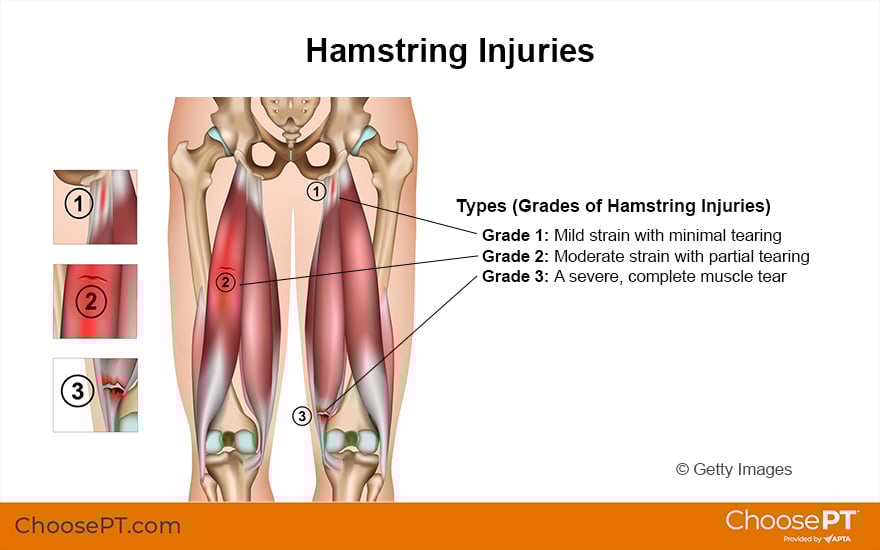
Typically, hamstring strain injuries are classified as Grade 1, 2, or 3:
- Grade 1: Mild strain with minimal tearing. It usually feels like a pulled or cramping muscle.
- Grade 2: Moderate strain with partial tearing. This may cause a stinging or burning sensation at the back of the thigh.
- Grade 3: A severe, complete muscle tear. This may cause a "lump" on the back of the thigh where the muscle has torn.
If your physical therapist suspects a severe injury (Grade 3), you will likely be referred to an orthopedic physician for medical diagnostic imaging, such as an X-ray or MRI. This can help to show the extent of the injury. If there is a fracture of the ischial tuberosity (the "sit-bone," part of the pelvis) and/or a complete rupture of the muscle, you may need surgery.
How Can a Physical Therapist Help?
You should seek help from a physical therapist immediately after a hamstring strain injury. This is especially important if swelling is significant or you can’t put weight on your leg. Continuing to walk or exercise on an injured hamstring can worsen the injury, potentially leading to more damage. Early treatment also can help you recover faster.
After your physical therapist evaluates your injury, they may advise you to:
- Rest the injured area for up to two weeks. Avoid aggravating activities, such as walking or working out. If you are having difficulty walking, you may need crutches. Your physical therapist will prescribe them. Do not overstress the injured area.
- Apply ice to the injured area.
After the initial rest period, your physical therapist will design a personalized treatment program based on your injury and your goals. Your treatment may include:
Manual therapy. Physical therapists are trained in manual (hands-on) therapy to gently move and manipulate muscles and joints. This can help improve your motion, flexibility, and strength. Your physical therapist may gently massage and move the affected area to encourage healing. These techniques can target areas that are difficult to treat on your own.
Range-of-motion exercises. Although it is common for your hamstring muscles to feel stiff after an injury, do not stretch them at first. Your physical therapist will indicate when it is safe to begin gentle exercises. They will teach you how to do them in the clinic and at home.
Muscle-strengthening exercises. Hamstring strengthening will be an essential part of your rehabilitation program. Your physical therapist will compare the strength of the muscle groups in each leg and teach you specific strengthening exercises.
Functional training. As you regain the strength in your hamstrings, your physical therapist will develop a slow and steady training program for the muscle group. This will help you safely return to more demanding activities, such as vigorous exercise or sports. Personalized training will help lessen any risk of reinjury. Returning to sport following a hamstring injury can take weeks to months.
If your hamstring strain injury requires surgical treatment, a physical therapist will guide your postoperative rehabilitation. Your physical therapist will communicate with your surgeon to ensure complete and consistent care.
Can This Injury or Condition Be Prevented?
You can decrease your risk of a hamstring strain injury in the following ways:
- Always warm up before participating in athletic activities.
- Avoid starting a new activity too quickly. Gradually increase the frequency and intensity of the activity. This will help the body adapt to your new movement patterns.
- Maintain the strength of your hamstring muscles.
- Listen to your body after you work out. Stretch, apply ice, and rest as needed before returning to the same routine.
What Kind of Physical Therapist Do I Need?
All physical therapists are prepared through education and experience to treat hamstring strain injuries. However, you may want to consider:
- A physical therapist who is experienced in treating people with hamstring strain injuries. Some physical therapists have a practice with an orthopedic or sports rehabilitation focus.
- A physical therapist who is a board-certified clinical specialist or who completed a residency or fellowship in orthopedics or sports physical therapy. This physical therapist has advanced knowledge, experience, and skills that may apply to your condition.
You can find physical therapists who have these and other credentials by using Find a PT , the online tool built by the American Physical Therapy Association, to help you search for physical therapists with specific clinical expertise in your geographic area.
General tips when you're looking for a physical therapist (or any other health care provider):
- Get recommendations from family, friends, or other health care providers.
- Ask about the physical therapists' experience in helping people with hamstring strain injuries.
- Be prepared to describe your symptoms in as much detail as possible, and report activities that make your symptoms worse.
The American Physical Therapy Association believes consumers should have easy access to clear, reliable information that helps them make informed health care decisions and feel prepared for visits with their providers.
The following resources offer the best scientific evidence on the physical therapy treatment of hamstring injuries. They cover recent research and standards of practice in the United States and globally. Whenever possible, they link to PubMed* abstracts (some of which offer free full-text access) or to other resources. You can read them to learn more or share them with your health care provider.
Hu C, Du Z, Tao M, Song Y. Effects of different hamstring eccentric exercise programs on preventing lower extremity injuries: a systematic review and meta-analysis. Int J Environ Res Public Health. 2023;20(3):2057. Article Summary in PubMed
Hickey JT, Opar DA, Weiss LJ, Heiderscheit BC. Hamstring strain injury rehabilitation. J Athl Train. 2022;57(2):125–135. Article Summary in PubMed
Hamstring strain injury in athletes. A summary of clinical practice guideline recommendations: using the evidence to guide physical therapist practice. J Orthop Sports Phys Ther. 2022;52(3):127–128. Article Summary in PubMed
Hamstring injury: what is it? What should I do about it? When can I get back to my sport? J Orthop Sports Phys Ther. 2022;52(3):129. Article Summary in PubMed
Sherry MA, Johnston TS, Heiderscheit BC. Rehabilitation of acute hamstring strain injuries. Clin Sports Med. 2015;34(2):263–284. Article Summary in PubMed .
Opar DA, Williams MD, Timmins RG, et al. Eccentric hamstring strength and hamstring injury risk in Australian footballers. Med Sci Sports Exerc. 2015;47(4):857–865. Article Summary in PubMed
Sanfilippo JL, Silder A, Sherry MA, et al. Hamstring strength and morphology progression after return to sport from injury. Med Sci Sports Exerc. 2013;45(3):448–454. Article Summary in PubMed .
Silder A, Sherry MA, Sanfilippo J, et al. Clinical and morphological changes following 2 rehabilitation programs for acute hamstring strain injuries: a randomized clinical trial. J Orthop Sports Phys Ther. 2013;43(5):284–299. Article Summary in PubMed .
Opar DA, Williams MD, Shield AJ. Hamstring strain injuries: factors that lead to injury and re-injury. Sports Med. 2012;42(3):209–226. Article Summary in PubMed .
Askling CM, Malliaropoulos N, Karlsson J. High-speed running type or stretching-type of hamstring injuries makes a difference to treatment and prognosis. Br J Sports Med. 2012;46(2):86–87. Article Summary in PubMed .
Heiderscheit BC, Sherry MA, Silder A, et al. Hamstring strain injuries: recommendations for diagnosis, rehabilitation, and injury prevention. J Orthop Sports Phys Ther. 2010;40(2):67–81. Article Summary in PubMed .
*PubMed is a free public website run by the National Library of Medicine. It allows people to access summaries and references from health research articles published in scientific journals, including those indexed in the MEDLINE database.
Expert Review:
Apr 30, 2025
Revised:
Apr 6, 2026
Content Type: Guide
Hamstring Injuries
PT, DPT, board-certified clinical specialist in sports physical therapy
Grace Naylor
PT, DPT, Certified Strength and Conditioning Specialist