
A stroke occurs when a blood vessel in the brain gets blocked or ruptures. It is the fourth leading cause of death in the United States and is a leading cause of serious, long-term disability in adults. Almost 800,000 people in the U.S. have a stroke each year.
Stroke can happen to anyone at any time — regardless of race, sex, or even age — but more women than men have a stroke each year, and African Americans have almost twice the risk of a first-ever stroke than Caucasians. Stroke risk increases with age, and most strokes occur in adults over 65. However, strokes are also happening more often in younger adults.
If you have one or more of the following symptoms, immediately call 911 or emergency medical services so that an ambulance can be sent for you:
- Sudden numbness or weakness of the face, arm, or leg, especially on one side of the body.
- Sudden confusion or trouble speaking or understanding
- Sudden trouble seeing in one or both eyes.
- Sudden trouble walking, dizziness, loss of balance or coordination
- Sudden, severe headache with no known cause.
If You Think Someone Might Be Having a Stroke
Act F.A.S.T.! Emergency treatment with a clot-buster drug called t-PA can help reduce or even eliminate problems from stroke. However, the medicine must be given as quickly as possible -- ideally within the first 3 hours of when symptoms start. The sooner the drug is given, the better the outcome. In some case the medication may be administered within 4.5 hours. Recognizing the symptoms can be easy by remembering to think F.A.S.T.
F = Face
Ask the person to smile. Does one side of the face droop?
A = Arms
Ask the person to raise both arms. Does one arm drift downward?
S = Speech
Ask the person to repeat a simple phrase. Does their speech sound slurred or strange?
T = Time
Note the exact time you noticed stroke symptoms. Call 911 and tell them the time that you think the stroke began.
Research shows that people with stroke who arrive at the hospital by ambulance receive faster evaluation and treatment than those who arrive by their own means.
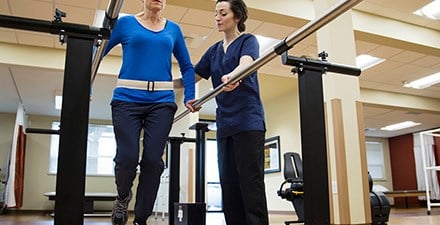
Physical therapists are movement experts who work with survivors of stroke to help them gain back as much function and strength as possible. They improve quality of life through hands-on care, patient education, and prescribed movement. You can contact a physical therapist directly for an evaluation. To find a physical therapist in your area, visit Find a PT.
Learn more about the role of physical therapy in treating patients who have experienced a stroke. And visit our health center on stroke for additional resources.